

Most organizations want each a cyber-focused TPRM platform and a compliance-focused TPRM platform, however it may be troublesome to see the place one instrument ends and the opposite begins. In the event you’re at present evaluating TPRM platforms, this information clarifies the variations between the 2.
What’s a cyber-focused TPRM platform?
A cyber-focused TPRM platform offers ongoing visibility into the safety posture of third-party distributors. It combines automated exterior monitoring with extra sources akin to questionnaires, AI doc evaluation, menace intelligence, and extra to construct a complete view of a vendor’s safety from an exterior perspective. This helps organizations perceive, assess, and observe vendor threat over time quite than counting on point-in-time assessments alone.
Cyber TPRM platforms (TPCRM) primarily reply these questions:
Does this vendor meet my group’s cybersecurity threat tolerance?Might their cybersecurity dangers disrupt our enterprise by means of breaches, outages, or downtime?
Core capabilities of a cyber-focused TPRM resolution usually embody:
Vendor discovery – uncovering identified and unknown suppliers by means of automated area intelligenceSecurity rankings and threat scoring – remodeling advanced safety knowledge into clear alerts that observe vendor posturesContinuous cyber threat monitoring – monitoring shifts in vendor safety hygiene and assault surfaces by means of each day scans and real-time alertsAutomated safety questionnaires – Business-aligned questionnaire templates that routinely floor dangers alongside vendor responsesIntegrated remediation workflows – changing recognized vulnerabilities into trackable remediation requests AI-Powered proof evaluation – using AI to research safety paperwork and public knowledge to keep up vendor evaluation momentumFourth-party mapping – figuring out downstream dependencies and repair overlaps to disclose focus dangers throughout your prolonged provide chainProgram oversight and reporting – producing defensible, real-time experiences and board-ready summaries to speak threat traits and display regulatory compliance
What these instruments do not concentrate on. If any of those capabilities are your main shopping for requirement, you are evaluating the improper TPRM platform class:
Sanctions compliance entity screening – checking distributors towards regulatory-grade world watchlists (like OFAC or EU lists) to make sure authorized eligibility for businessOwnership mapping – figuring out Final Helpful House owners (UBOs) and complicated company hierarchies to uncover hidden affect or controlKYC/AML/ABAC workflows – performing “Know Your Customer”, Anti-Cash Laundering checks to confirm the monetary legitimacy of a enterprise associate and Anti-Bribery/Anti-CorruptionNegative information monitoring – monitoring of credible media and public sources to determine opposed details about third events akin to allegations of fraud and corruption PEP checks – figuring out Politically Uncovered Individuals inside a vendor’s management who would possibly pose the next threat of bribery or corruptionInvestigation case administration – offering structured audit trails and authorized workflow instruments to doc and resolve compliance-related purple flagsPrimary consumers embody CISOs, safety operations groups, and vendor threat administration leads.What’s a compliance-focused TPRM platform?
A compliance-focused TPRM platform manages vendor due diligence from the authorized and regulatory angle. It handles the workflows that compliance, authorized, and procurement groups must conduct preliminary due diligence and constantly monitor distributors all through their lifecycle
Compliance-focused TPRM platforms primarily reply these questions:
Is that this vendor legally and regulatorily clear?Are there possession, sanctions, or corruption dangers that would expose our group?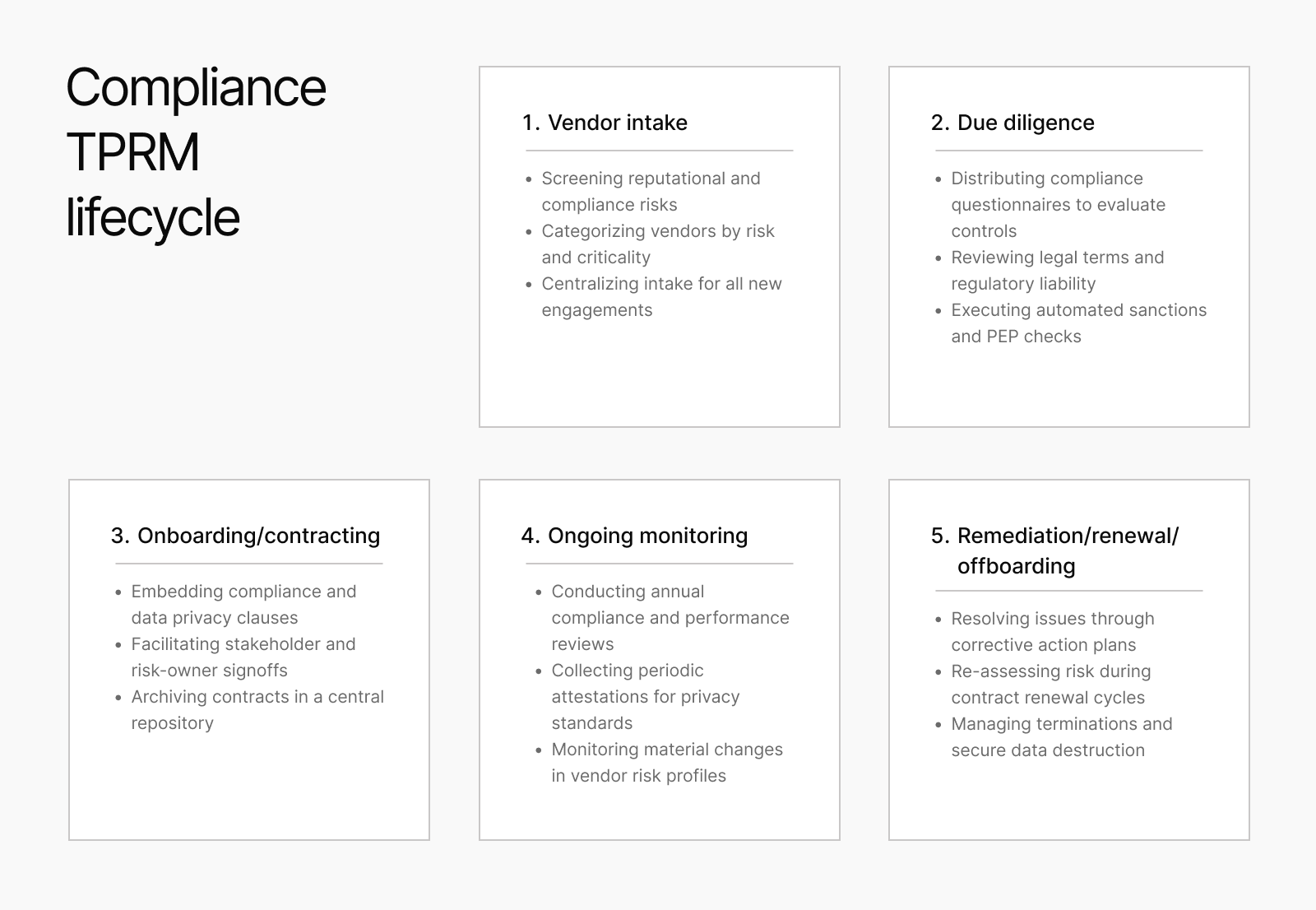
Core capabilities usually embody:
Sanctions and denied-party screening – cross-referencing entities towards world watchlists (OFAC, EU, UN) to make sure compliance with commerce and authorized restrictionsPolitically Uncovered Particular person (PEP) identification – flagging people in outstanding public roles who carry an elevated threat for bribery, corruption, or cash launderingAdverse media monitoring – scanning world information and public databases for unfavorable press or authorized points that would point out reputational or integrity risksUltimate Helpful Possession (UBO) mapping – tracing company hierarchies to determine the pure individuals who finally personal or management an entityAnti-bribery and anti-corruption (ABAC) checks – vetting distributors for historical past or indicators of moral violations associated to frameworks just like the FCPA or UK Bribery ActInvestigation case administration – centralizing red-flag documentation and remediation workflows inside a safe, audit-ready system for authorized groups
What these instruments do not do:
Steady cyber posture monitoring – offering real-time visibility into the technical safety well being of a vendor’s external-facing IT infrastructureVulnerability scanning – figuring out technical flaws, akin to unpatched software program or open ports, that would result in a safety breachBreach detection – trying to find proof of energetic or historic knowledge compromises, akin to leaked credentials on the darkish webSecurity rankings – producing a numerical rating or grade primarily based on technical threat elements to benchmark a vendor’s safety performancePrimary consumers embody Chief Compliance Officers, Basic Counsel, compliance managers, and procurement leads.The place the 2 TPRM platform classes overlap
The confusion between cyber TPRM and compliance TPRM virtually all the time begins within the overlap zone, not the variations.
Earlier than devoted Cyber TPRM platforms existed, most instruments dealt with cybersecurity threat by means of guide questionnaires and static documentation. For a time, many organizations thought-about this ample.
However as cyber threat grew to become extra important and expensive, organizations acknowledged that InfoSec groups wanted specialised instruments to constantly monitor vendor safety posture, which led to the class divide.
Each cyber TPRM and TPRM options handle vendor inventories, tier distributors by threat degree, and produce threat experiences for boards and auditors. Due to this overlap, consumers typically assume one instrument covers each TPRM classes, however that’s not true.
This is a breakdown of the place the classes diverge:
Dimension
Cyber TPRM
Compliance TPRM
Knowledge sources
Exterior scanning, DNS, IP intelligence, darkish internet, breach databases
Sanctions lists, PEP databases, company registries, opposed media
Danger sorts
Vulnerabilities, misconfigurations, knowledge leaks, and ransomware publicity
Sanctions threat, corruption / bribery threat, regulatory compliance threat
Monitoring cadence
Steady (each day or weekly scans)
Occasion-driven (onboarding, periodic evaluations, listing updates); Steady monitoring for unfavorable evaluations, sanctions, watchlists, and so on.
Output
Danger rating or ranking
Screening alerts, investigation experiences, questionnaire responses
Major purchaser
CISO, safety workforce
CCO, authorized, procurement
Shared territory
Vendor stock, threat tiering, reporting dashboards
Vendor stock, threat tiering, reporting dashboards
Getting this improper creates two varieties of blindspots:
A company relying completely on cyber TPRM has no visibility into whether or not a vendor is sanctioned, faces regulatory motion, or carries export management violations.
A company relying completely on compliance TPRM has no sign on whether or not that vendor’s infrastructure is weak, their credentials are circulating on the darkish internet, or their area safety is misconfigured for phishing.
The place the hole lives
In an period of rising political stress and world battle, a vendor’s geographic footprint is now a safety sign.
Geopolitical stress typically correlates with an elevated threat of state-sponsored menace actors or heightened dangers relating to knowledge residency in areas with excessive political instability.
For instance, storing delicate knowledge in a jurisdiction the place the federal government exerts absolute management over infrastructure is a important cyber threat that conventional technical scanning would possibly miss.
Tracing these regional dangers and political affiliations is important for contemporary safety groups. It offers the mandatory context for figuring out the probability of a vendor serving as a strategic entry level for state-sponsored assaults or unauthorized knowledge entry.
How the market is responding
The TPRM market is converging as a result of consumers want each cyber and geopolitical visibility however need to keep away from the friction of managing two completely separate knowledge fashions. The aim is not essentially to switch devoted compliance platforms—which authorized groups nonetheless want for deep-dive investigations and UBO mapping—however to enrich them.
By embedding geopolitical alerts immediately into the cyber TPRM platforms that safety groups are already utilizing, organizations can shut the detection hole. This enables safety results in see a vendor’s regional and political threat alongside their technical vulnerabilities, offering a extra holistic view of the menace panorama with out forcing a instrument consolidation that sacrifices depth.
How Cybersecurity is responding
Cybersecurity is responding to the market’s sentiment by surfacing geopolitical insights alongside technical safety knowledge in the identical vendor profile, making a single view of technical posture and regulatory historical past within the one platform.
Cybersecurity’s geopolitical and sanctions dangers function on the group degree: entity-to-entity matching towards world sanctions and enforcement databases, verified by AI to cut back false positives.
What Cybersecurity would not try to switch is the deep compliance tooling authorized groups want for UBO mapping, PEP screening, FOCI determinations, and investigation case administration. That work requires completely different knowledge, completely different authorized experience, and completely different stakeholder possession.
What Cybersecurity covers:
Functionality
Cybersecurity covers this?
Requires compliance tooling?
Vendor on a sanctions listing
✓
Elective — Cybersecurity offers the detection sign
Sanctions violation or export management violation
✓
Escalation to authorized for remediation
Regulatory motion or debarment
✓
Escalation to authorized for remediation
PEP screening (particular person degree)
✗
Sure — compliance platform required
UBO and useful possession mapping
(Partial)
Sure — compliance platform required
FOCI willpower
✗
Sure — authorized counsel and compliance tooling
KYC/AML compliance workflows
✗
Sure — compliance platform required
Investigation case administration
✗
Sure — compliance platform required
Steady cyber posture monitoring
✓
Not relevant — compliance instruments do not cowl this
Determination framework: Cyber TPRM or Compliance TPRM?
Use the next framework to work by means of the choice to your group.
In case your main concern is whether or not a vendor’s technical weaknesses might grow to be your breach:
Begin with a cyber-focused TPRM platform. That is the core perform of the class — steady exterior monitoring of vendor safety posture, with no vendor cooperation required.
In case your main concern is whether or not a vendor is owned by sanctioned entities, and whether or not you might have KYC documentation for regulators:
A compliance-focused TPRM platform is the suitable instrument. These platforms are designed particularly for authorized and procurement workflows, they usually carry the info depth that possession and sanctions evaluation requires.
In the event you want each alerts however need to begin with one platform:
A cyber TPRM platform with built-in geopolitical threat alerts offers the broadest single-platform protection for security-led vendor threat applications. Sanctions and regulatory publicity floor in the identical workflow as technical findings, and the escalation path to compliance tooling or authorized counsel is obvious when a discovering requires deeper investigation.
If you have already got a mature compliance program:
A cyber TPRM platform enhances your present compliance stack with out changing it. Safety groups get cyber and regulatory alerts in a single platform. Compliance groups proceed to make use of their devoted instruments for possession evaluation, PEP screening, and case administration. The 2 platforms serve completely different consumers with completely different workflows — and that is the suitable structure, not a spot to shut.
Begin enriching your cybersecurity analysis with Cybersecurity
Cybersecurity bridges the hole between technical scanning and the advanced world of geopolitical threat. By integrating geopolitical insights immediately into your safety workflow, you’ll be able to consider the true resilience of your provide chain towards regional instabilities and state-sponsored threats.
In case you are a safety workforce that should perceive the hyperlink between a vendor’s regulatory historical past, geographic footprint, and their general cyber threat, Cybersecurity surfaces these alerts alongside your technical findings.
.jpg "Cyber TPRM vs Compliance TPRM: Which is best for you? | Cybersecurity 2")

