

The platforms your clients belief to attach together with your model at the moment are being weaponized to destroy its repute. AI is equipping cybercriminals with industrial-scale operations that may replicate your model presence throughout all main social platforms in simply minutes.
This information supplies a CISO’s framework for shifting from reactive model monitoring to proactive risk disruption, detailing a four-pillar plan to neutralize these threats earlier than they impression your online business.
The daybreak of industrial-scale model impersonation
The risk panorama of impersonation assaults has modified ceaselessly. Model impersonation now contains 51% of all browser-based phishing makes an attempt. This is not a current emergence. In 2024, model impersonation assaults elevated by 42%, and since then, Microsoft has prevented over 5,000 credential thefts by way of social media phishing.
Since ChatGPT’s launch in late 2022, phishing assaults have grown by 4,151%, indicating that, unsurprisingly, AI is the mechanism driving this insurgency.
Social Media Model Impersonation Risk Progress 2023-2025.The mid-market vulnerability hole
This risk is especially acute for mid-market organizations (500-10,000 staff), offering the right situations for exploitation — most publicity with minimal protection functionality.
Their vulnerability is pushed by:
Lean safety groups: Small groups of 5-20 individuals lack the bandwidth to constantly monitor a number of social media platforms.Restricted visibility: A reliance on conventional, perimeter-based safety instruments creates a large blind spot for social media threats.Government publicity: Public-facing management roles make executives enticing and straightforward targets for impersonation.SOC overload: With over 252,000 new web sites created day by day and tens of hundreds of malicious URLs detected by Proofpoint in simply months, the sheer quantity of potential threats overwhelms safety operations facilities (SOCs) and human-led response capabilities.The end result is an ideal storm: most publicity with minimal protection functionality.How standard social platforms are being exploited
Understanding how attackers abuse every main social media platform is vital for constructing ample defenses.
1. Fb/Meta
Fb has change into the epicenter of systematic model impersonation. The assault methodology is ruthlessly environment friendly. Risk actors create faux enterprise pages that mirror reputable manufacturers, then use Fb’s promoting system to advertise phishing content material on to focused worker lists harvested from LinkedIn.
Examples of impersonation assaults on Fb
“Facebook guest” rip-off: A widespread marketing campaign often called the “Facebook Guest” rip-off targets enterprise pages with distressing messages falsely claiming that the web page’s content material has violated copyright or group requirements. These messages, which comprise hyperlinks to credential-stealing web sites, are fairly convincing, even to cyber threat-aware customers.Malicious model promoting: Risk actors create malicious ads that mimic reputable manufacturers after which use Fb’s advert system to focus on particular customers with phishing content material.Faux job ads: Fraudsters publish faux job ads on Fb, impersonating an actual firm or a recruitment company. The purpose is to trick candidates into paying upfront for “training” or “background checks,” or to reap their private info for id theft. 2. LinkedIn
Attackers exploit LinkedIn’s credibility by creating faux govt profiles. They then use these personas to request delicate info or credentials from staff who consider they’re speaking with reputable management.
Examples of impersonation assaults on LinkedIn:
Faux profiles: Attackers create faux profiles to ship connection requests to customers. These profiles typically have purple flags, reminiscent of utilizing inventory images, having incomplete or imprecise particulars, and displaying a normal lack of engagement, like posts or feedback. These faux connections are sometimes step one in a bigger rip-off.Phishing scams: After connecting with a goal, scammers ship convincing messages containing hyperlinks designed to steal credentials or deploy malware. Attackers might also impersonate official LinkedIn communications to trick customers into clicking these malicious hyperlinks.Faux job provide scams: Scammers could impersonate recruiters or use faux worker profiles to publish fraudulent listings containing credential-stealing hyperlinks.Crypto funding scams: This can be a rising risk wherein scammers impersonate monetary specialists or different reputable professionals. They ship unsolicited messages promising excessive, assured returns on crypto investments and strain victims to behave quick earlier than the “opportunity” is gone. A current instance of that is the indictment of the Chairman of Prince Group, ensuing within the largest-ever foreclosures motion. 3. X/Twitter
X/Twitter’s structure supplies a number of exploitation alternatives. The platform’s real-time nature and trending algorithms make it significantly efficient for quickly amplifying campaigns. Attackers exploit viral mechanics by creating faux disaster eventualities or pressing bulletins that seem to come back from reputable company accounts.
The pace of knowledge unfold on X/Twitter means malicious content material can attain hundreds of potential victims earlier than conventional monitoring techniques can detect and reply to the risk.
Examples of impersonation assaults on X/Twitter
Hyperlink shortener abuse: Risk actors use X/Twitter’s native hyperlink shortener, t.co, to cover malicious hyperlinks and ship credential phishing payloads. In a particular assault, a t.co hyperlink was embedded in a phishing e-mail that impersonated DocuSign. When clicked, the hyperlink took the goal to a touchdown web page that includes each Adobe and Microsoft model impersonations, with the final word purpose of harvesting credentials by an Adversary-in-the-Center (AITM) assault.Advert URL spoofing for crypto scams: A complicated rip-off exploits a vulnerability within the promoting show URL function on X/Twitter. Attackers create advertisements displaying a legitimate-looking hyperlink, reminiscent of one from CNN.com, however redirect customers to a malicious cryptocurrency rip-off web site. The enterprise impression
The monetary impression of social media model impersonation extends far past conventional breach prices. It creates a disaster of buyer belief with staggering multiplier results.
Analysis exhibits that 63% of customers blame the genuine model for impersonation assaults, whatever the firm’s involvement. This misplaced blame is devastating as a result of:
It’s as much as 7x costlier to amass a brand new buyer than to retain an current one.The likelihood of promoting to an current buyer is 60-70%, in comparison with simply 5-20% for a brand new prospect.
In accordance with Splunk evaluation, the typical group faces important monetary fallout, together with $49M in misplaced income yearly for World 2000 firms, a 2.5% common drop in inventory value per incident, and $14M in annual disaster administration prices.
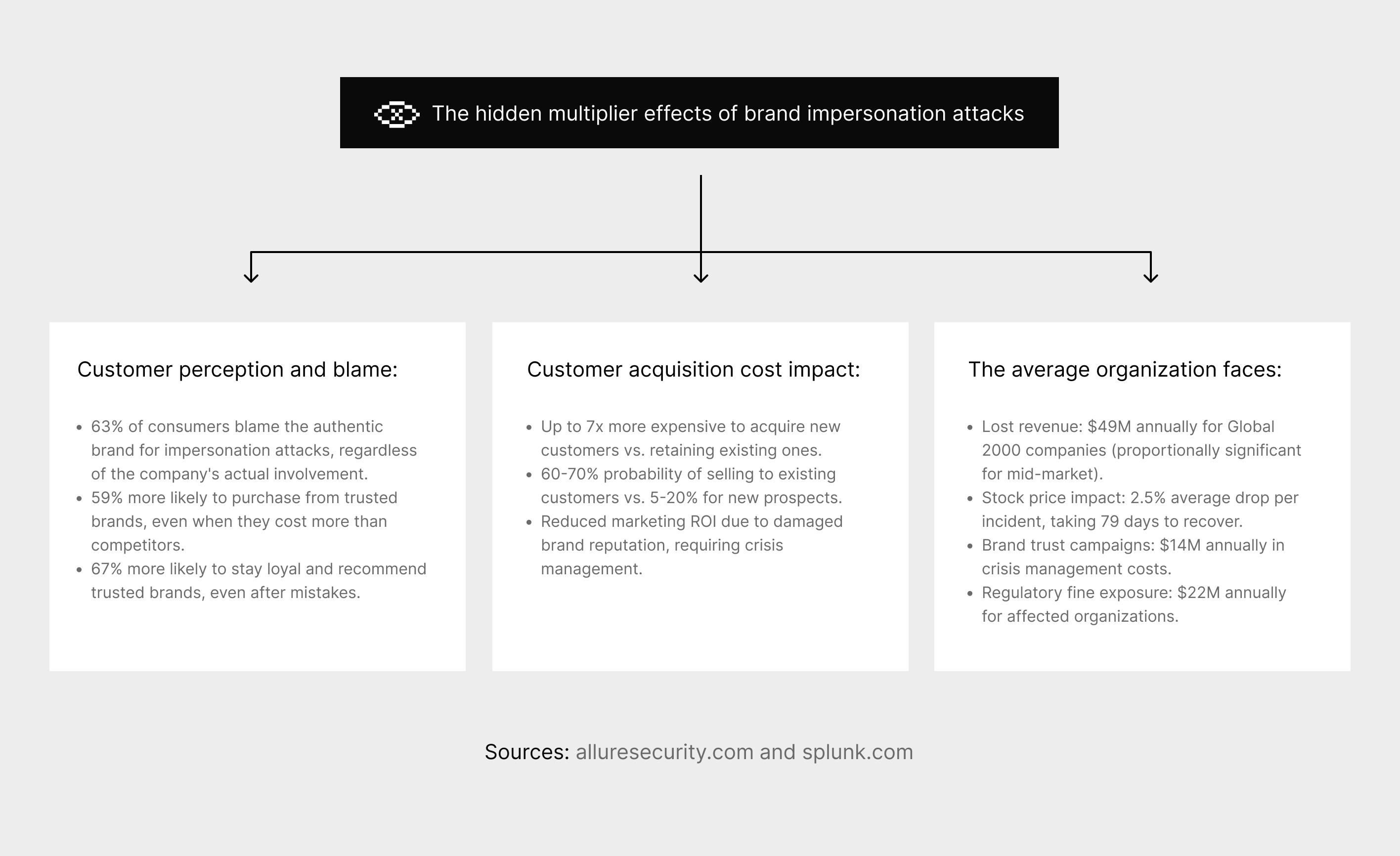 The hidden multiplier results of brand name impersonation assaults.Anatomy of a contemporary impersonation assault marketing campaign
Trendy attackers do not function on a single platform; they execute coordinated, multi-platform campaigns that make detection tougher. A typical playbook includes:
Reconnaissance (LinkedIn): Attackers scrape LinkedIn for high-value targets, organizational constructions, and worker lists. The platform’s skilled context makes it a goldmine for plausible social engineering.Impersonation (Fb/Meta): Utilizing the harvested knowledge, risk actors create faux enterprise pages that completely mirror a reputable model, establishing a fraudulent—however credible—presence.Amplification (X/Twitter): The platform’s real-time nature is exploited to quickly unfold malicious hyperlinks, typically by manufacturing faux disaster eventualities or pressing bulletins that seem to come back from official company accounts.Diversification (Instagram, TikTok, Reddit): Attackers create content material tailor-made to youthful demographics on Instagram and TikTok or infiltrate Reddit communities to construct credibility earlier than launching an assault.This coordinated method makes detection exponentially tougher for safety groups monitoring platforms in isolation.
This multi-platform tactic demonstrates that these incidents are usually not remoted however normally a part of a broader compromise technique, generally scaling to an unlimited cybercrime enterprise. Inside the Microsoft ecosystem alone, tried fraud and scams have been valued at roughly $4 billion over a 12-month interval.
Case Research: The LinkedIn Government Impersonation Marketing campaign
A current marketing campaign focusing on mid-market know-how firms illustrates the delicate nature of contemporary social media assaults.
The Assault: Attackers scraped LinkedIn to establish C-level executives and their direct stories. They created faux govt profiles utilizing AI-generated headshots and despatched connection requests to staff. As soon as linked, the faux executives despatched “urgent document review” requests, resulting in credential harvesting pages.The Impression: The marketing campaign compromised over 1,200 worker accounts throughout 47 organizations earlier than it was detected. The typical dwell time was 23 days. Affected organizations confronted: $340,000 common incident response prices per organization14% buyer churn charge following disclosure of the breach6-month restoration interval for full belief restoration
A better take a look at the assault chain:
Step 1: Reconnaissance – Attackers scraped LinkedIn to establish C-level executives and their direct stories throughout 200+ firms within the know-how sector.Step 2: Profile creation – Faux LinkedIn profiles have been created utilizing AI-generated headshots and scraped biographical info from reputable govt profiles.Step 3: Community infiltration – The faux profiles despatched connection requests to staff, attaining a 34% acceptance charge by focusing on lower-level employees flattered by the obvious consideration of C-level executives.Step 4: Credential harvesting – As soon as connections have been established, the faux executives despatched pressing requests for “urgent document review” that led to credential harvesting pages hosted on trusted domains.Step 5: Lateral motion – Stolen credentials have been used to entry company techniques and provoke inside phishing campaigns focusing on further staff.A CISO’s motion plan: 4 pillars for social media protection
Defending towards industrial-scale social media impersonation requires a scientific method that anticipates assaults fairly than reacting to them.
Pillar 1: Implement complete social media risk intelligence
CISOs should set up steady monitoring throughout all main social platforms with automated risk detection capabilities.
1. Deploy automated model monitoring throughout six core platforms
Your monitoring technique should transcend easy key phrase matching. Your automated answer ought to scan for not solely the unauthorized use of brand name names, logos, and govt imagery, but in addition for permutations of those property. This contains monitoring for deceptively comparable domains utilized in self-importance URLs and slight brand alterations designed to idiot the human eye.
Superior techniques leverage AI-powered picture recognition and Pure Language Processing (NLP) to establish these subtle impersonation makes an attempt throughout social platforms.
On the very least, throughout Fb, LinkedIn, X/Twitter, Instagram, TikTok, and Reddit, your monitoring should scan for:
Unauthorized use of brand name names, logos, and govt imageryFake accounts impersonating firm personnelSuspicious pages or teams utilizing firm brandingCoordination between a number of faux accounts2. Combine social media intelligence with current risk feeds
Integrating social media intelligence into your broader safety ecosystem supplies vital context. For instance, correlating a suspicious social media profile with a lately registered phishing area or a point out on a darkish internet discussion board supplies a high-fidelity sign of a coordinated assault.
By connecting disparate occasions on this method safety groups shift from from reacting to particular person alerts to proactively dismantling whole assault campaigns — a holistic technique instantly mapping to the Direct, Reply and Get better features of the NIST CSF.
 Social media monitoring initiatives map to the Direct, Reply, and Get better features of the NIST CSF.3. Set up real-time alerting with clever prioritization
The sheer quantity of social media mentions makes handbook triage not possible. An efficient technique depends on automated, risk-based alerting. As a substitute of a chronological feed of each point out, alerts must be prioritized based mostly on a calculated threat rating.
Pillar 2: Create govt safety packages
C-level executives and different high-visibility personnel require specialised social media safety as a result of their elevated threat profile.
1. Conduct complete digital footprint assessments for all executives
This course of includes a radical Open-Supply Intelligence (OSINT) investigation to map out an govt’s full public-facing assault floor. This goes past cataloging their skilled social media accounts to establish publicly obtainable private info — reminiscent of members of the family’ names, location knowledge from picture metadata, and private pursuits shared on boards — that could possibly be weaponized in a social engineering assault.
After defining the digital footprints of all individuals of curiosity, consider their threat ranges based mostly on the diploma of their assault surfaces.
The purpose is to establish and remediate extreme public knowledge publicity by tightening privateness settings and training executives on safer on-line practices.2. Second, implement govt account monitoring
Steady monitoring must be in place to detect the creation of “clone accounts” that meticulously replicate an govt’s actual profile. This contains monitoring unauthorized accounts utilizing their identify or AI-generated deepfakes of their images.
The monitoring must also lengthen to mentions of the manager in uncommon contexts or on platforms they don’t use, as this generally is a precursor to an upcoming assault. The system must be able to flagging suspicious login makes an attempt and API connections to their reputable accounts, indicating a possible account takeover in progress.
A monitoring technique ought to monitor:
Unauthorized accounts utilizing govt names or photosAttempts to pal/join with govt accounts from suspicious profilesMentions of executives in probably malicious contexts3. Set up fast response protocols
For govt impersonation incidents, together with direct communication channels with platform abuse groups and authorized procedures for emergency takedowns.
When an govt impersonation is detected, a pre-defined and well-rehearsed incident response plan is vital. This protocol ought to embody established factors of contact to expedite emergency account takedowns, and pre-drafted cease-and-desist templates prepared for authorized counsel to dispatch.
An incident response protocol should additionally embody a transparent communications plan for alerting staff, key stakeholders, and probably the general public to the impersonation try to forestall additional harm.
Pillar 3: Automate risk response and remediation
The pace of social media threats calls for automated response capabilities that may act sooner than human operators.
1. Set up automated takedown workflows
Upon detecting a malicious web page, the system ought to robotically provoke a workflow that captures digital proof (e.g., screenshots, community logs), codecs it in response to every platform’s distinctive abuse reporting necessities, and submits the takedown request by way of API.
Automated workflows ought to concurrently:
Submit abuse stories to platform providersBlock malicious domains at company internet gatewaysAlert affected staff about ongoing impersonation attemptsDocument incidents for compliance and authorized purposesAutomated takedown workflows will scale back a course of that when took hours of handbook effort to mere minutes, considerably shrinking the window of alternative for attackers.2. Implement user-level automated responses
If an worker stories a social media phishing hyperlink, a Safety Orchestration, Automation, and Response (SOAR) playbook might be triggered, the place a suspicious URL is detonated in a sandbox for evaluation, and if confirmed to be malicious, triggers a set of further follow-up responses to thwart the assault, reminiscent of:
lock the area related to the malicious hyperlink on company internet filters;revoke the reporting person’s lively classes;power a password reset;sweep e-mail gateways for another situations of the identical malicious hyperlink, andscan for associated indicators of compromise throughout company techniques.Initiating incident response procedures with out handbook intervention prevents a single click on from escalating into an enterprise-wide breach.3. Create suggestions loops for risk intelligence enchancment.
Every mitigated assault ought to strengthen your total safety posture. Indicators of Compromise (IoCs) — reminiscent of malicious URLs, domains, and usernames — from a confirmed social media risk must be robotically fed again into your whole safety stack.
For instance, a malicious area is added to the blocklist to your DNS firewall and Safe Internet Gateway, related file hashes are added to your Endpoint Detection and Response (EDR) platform, and new detection guidelines are created in your SIEM.
This suggestions loop ensures your defenses study from each incident, making a constantly enhancing, self-hardening ecosystem.Pillar 4: Strengthen the final line of protection
CISOs should assume that some social media-based phishing makes an attempt will succeed and deal with making stolen credentials nugatory.
1. Mandate phishing-resistant MFA throughout all company techniques.
Not all Multi-Issue Authentication is created equal. As CISA strongly advocates, organizations should transfer past bypassable strategies like SMS and push notifications. Phishing-resistant MFA, based mostly on requirements like FIDO2/WebAuthn, is the gold normal.
This methodology, which makes use of {hardware} safety keys or device-bound passkeys, creates a cryptographic bond between the person and the reputable service. If an worker is tricked into visiting a phishing web site, the authenticator is not going to work as a result of the area doesn’t match, rendering the stolen credentials ineffective.
2. Implement zero-trust structure
A zero-trust mannequin assumes that no person or system is inherently reliable. Each entry request should be constantly verified. This implies implementing community micro-segmentation to forestall lateral motion, so a compromised account in a single division can’t entry delicate knowledge in one other.
It additionally includes deploying Consumer and Entity Conduct Analytics (UEBA) to detect anomalous exercise, reminiscent of a person logging in from a brand new geographic location or accessing uncommon recordsdata, which might point out a compromised account.
3. Set up complete incident response procedures
Your incident response plan should embody particular playbooks for breaches originating from social media. These ought to element the steps for dealing with a large-scale buyer PII leak from a faux assist web page, managing public relations throughout a brand-damaging disinformation marketing campaign, and guaranteeing compliance with regulatory notification necessities like GDPR.
These playbooks must be examined rigorously and usually by tabletop workout routines involving cross-functional groups, together with safety, authorized, advertising, and govt management.
The benefit of early adoption
Mid-market CISOs have two decisions: put money into social media risk monitoring now or settle for the inevitability of taking part in protection towards industrial-scale model impersonation campaigns sooner or later.
For organizations that act proactively, the advantages lengthen past easy protection, creating tangible enterprise worth:
How Cybersecurity permits proactive social media risk monitoring
Implementing protection towards industrial-scale social media impersonation requires steady, automated visibility throughout a number of platforms concurrently. The pace of contemporary assaults means a malicious account might be created, used for credential harvesting, and deleted earlier than conventional model monitoring providers even detect it.
Cybersecurity’s new Social Media Monitoring functionality is designed for this actuality. As a substitute of periodic model searches that miss time-sensitive threats, the platform supplies:
Automated Model Discovery throughout Fb, LinkedIn, X/Twitter, Instagram, TikTok, and Reddit, with pre-populated monitoring based mostly in your group’s area and current model property.Clever Risk Classification that robotically categorizes detected accounts as Official, Protected, Suspicious, or Fraudulent, lowering alert fatigue whereas guaranteeing real threats obtain quick consideration.Unified Risk Feed Integration that correlates social media impersonation makes an attempt with darkish internet credential leaks and assault floor vulnerabilities, offering full context for risk prioritization.Guided Remediation Workflows that present step-by-step takedown procedures for every platform, streamlining response for lean safety groups with out specialised social media experience. Social media monitoring by Cybersecurity.
This proactive method supplies the vital early warning wanted to disrupt assaults earlier than they attain staff or clients, neutralizing threats on the supply fairly than responding to profitable compromises.
To study extra, get a tour of the Cybersecurity platform.

