

Cyber risk monitoring is important for efficient cybersecurity, but most organizations function with gaping blind spots. On this put up, we shed some gentle on the constraints of standard approaches that will help you obtain complete visibility of your assault floor.
Why organizations want real-time visibility
Traditionally, risk detection was primarily reactive, counting on signature-based instruments and rule-based programs to search out recognized patterns of malicious exercise in community logs and information. This method was efficient when knowledge units had been smaller and threats had been well-documented, nevertheless it struggled to maintain tempo as cyber risk knowledge complexity and quantity exploded.
The introduction of machine studying (ML) and deep studying to cybersecurity packages injected new power into detection methods, enabling safety groups to establish cyber risk patterns precisely and with the pace essential to sustain with fashionable cyber assault strategies.
At the moment, the newest evolution of cyber risk monitoring is being formed by Synthetic Intelligence, notably Giant Language Fashions (LLMs). This newest spherical of developments is altering detection capabilities in a number of methods:
Including Context to Detection: Whereas earlier ML fashions may flag a file as malicious, they could not clarify why. LLMs, skilled on numerous data together with unstructured risk intelligence stories, can now present essential context behind a choice, delivering a extra knowledgeable response relatively than only a binary alert. Consequently, cyber risk remediation actions at the moment are extra focused and being deployed quicker than ever.Comprehending Complicated Information: LLMs have demonstrated a shocking means to know and establish malicious exercise inside knowledge codecs that aren’t conventional prose. This consists of log information, code, JSON, and even malware hashes, considerably increasing the scope of information that may be mechanically analyzed for cyber dangers.This shift from on the lookout for recognized signatures to analyzing behaviors and understanding context permits safety groups to establish and even anticipate unknown threats earlier than they will trigger important harm.The excessive price of dwell time
In cybersecurity, time is the attacker’s most beneficial useful resource. The longer they continue to be undetected inside a community, the extra harm they will inflict. The safety {industry} has made important progress in decreasing attacker dwell time over the past decade, from 16 days in 2022 to only 10 days in 2023. However whereas this will likely seem to be a formidable enchancment, 10 days continues to be an eternity for cybercriminals, particularly for individuals who have bolstered their assault methods with Al expertise.
The important levels of a cyber assault, equivalent to knowledge exfiltration through an SQL injection or a “smash and grab” ransomware deployment, can now happen in simply minutes or hours, making even a multi-day dwell time far too lengthy to forestall important monetary harm.
The challenges of a contemporary dynamic assault floor
The widespread adoption of cloud-based structure, the permanence of distant work, and the rise of dynamic virtualized property have dissolved conventional community boundaries, making a perimeter-less actuality that introduces new and sophisticated dangers.
The assault floor now extends far past the company workplace, encompassing cloud misconfigurations, insecure house networks, and extremely transient digital property which are tough to trace.
This expanded, dynamic assault floor creates important monitoring challenges that legacy safety instruments weren’t designed to deal with:
Visibility Gaps in IaaS/PaaS: Efficient cloud surroundings monitoring requires enabling and centrally accumulating a number of log sources — equivalent to community site visitors logs, storage entry logs, and audit logs — however the high quality and availability of this knowledge can rely closely on the group’s particular cloud subscription degree.Securing Unmanaged Units: With distant and hybrid workforces, the chance shifts to particular person customers and their endpoints. Company credentials might be compromised on private or contractor gadgets used for work, particularly if these gadgets are additionally utilized in Shadow IT or Shadow SaaS practices. Securing these unmanaged “Bring Your Own Device” (BYOD) property is a significant problem, as organizations can not implement safety controls on programs they don’t personal.Monitoring Transient Digital Belongings: Trendy cloud-native environments more and more use ephemeral workloads, that are transient by nature and will exist for just a few minutes, for instance, an ephemeral container used for troubleshooting safe, minimal “distroless” purposes in Kubernetes. As a result of these property are so short-lived, conventional safety scanning or agent-based monitoring could miss them fully, creating blind spots the place an attacker may execute instructions or exfiltrate knowledge with out leaving a persistent footprint.
The rising adoption of generative AI options amongst third-party distributors creates specific monitoring challenges, particularly in Shadow IT. Watch this video to be taught extra.
Discover Cybersecurity Consumer Danger >
Compliance and reputational dangers
Past the fast technical challenges, insufficient risk monitoring exposes organizations to extreme enterprise dangers, beginning with regulatory non-compliance.
A rising variety of world and industry-specific frameworks — equivalent to GDPR, HIPAA, PCI DSS, DORA, and CIRCIA — mandate or strongly suggest the necessity for steady monitoring to guard delicate knowledge. Nevertheless, with attackers now leveraging AI, legacy monitoring approaches can not successfully monitor for rising cyber threats, making compliance with these laws more and more tough.
Failure to sharpen monitoring capabilities with fashionable methods results in important fines and erodes model belief, a main driver of information breach prices attributable to buyer turnover and status harm.
Crucial strategies to establish cyber threats
Understanding the necessity for real-time visibility is step one to bettering cyber risk monitoring. The subsequent step is implementing the right strategies to realize it. Shifting from principle to apply requires adopting proactive, superior methods that align with the realities of the trendy cyber risk panorama.
It’s essential shift your focus from merely defending the IT perimeter to actively attempting to find threats which will already be working inside.
This new and improved method to cyber risk monitoring might be carried out with the next methods:
1. Undertake an “assume breach” mindset
It is time to lastly abandon the outdated “castle-and-moat” safety mannequin in favor of Zero-Belief ideas based mostly on an “assume breach” mindset.
In line with the normal “castle-and-moat” method, anybody contained in the community is trusted by default. The important flaw on this technique is that after an attacker crosses the “moat” — whether or not by means of stolen credentials, malware, or a social engineering assault — they transition right into a reliable standing, which grants them free entry to inside purposes and delicate knowledge.
In distinction, a contemporary Zero Belief safety framework operates on the core precept of “Never Trust, Always Verify.” This method begins with the idea {that a} breach has already occurred and that safety dangers are current each inside and out of doors the community.
No person, system, or connection is trusted by default, no matter location. As a substitute, Zero Belief requires customers to constantly confirm their id with each try to entry delicate sources.
An assume breach mindset is an ever-present philosophy, instantly carried out on the onboarding stage, the place a person’s degree of system entry is the minimal required to carry out their duties, often known as the Precept of Least Privilege.
An assume breach mindset can even naturally pivot your cybersecurity technique in the direction of enhanced give attention to mitigating insider threats, getting ready the bottom for a human cyber threat administration program.
2. Monitor the darkish net
An “assume breach” mindset requires proactive intelligence-gathering outdoors your community. A important supply for that is the darkish net, which hosts 1000’s of illicit marketplaces and boards the place delicate company data is usually traded or leaked following a breach.
Trendy cyber risk monitoring includes the continual, automated scanning of those sources — together with ransomware blogs, boards, credential dumps, and encrypted messaging platforms like Telegram — to search out intelligence related to your group’s digital footprint, equivalent to:
Leaked company or worker credentials.Uncovered delicate buyer knowledge, just like the personal medical data leaked within the Medibank cyber assault.Mentions of your model or executives.The sale of proprietary firm knowledge or mental property.
The first worth of darkish net monitoring is its operate as an early warning system of an impending breach. Many organizations wrestle with this side of cyber risk monitoring. Consequently, their compromised delicate knowledge circulates throughout darkish net marketplaces for weeks and even months with out their information.
The damaging implications of dwell time prolong to leaks on the darkish net. Credentials posted in a knowledge dump might be harvested and utilized in credential stuffing assaults inside hours. By detecting this publicity in close to real-time, safety groups can take preemptive motion — equivalent to resetting compromised passwords or notifying affected customers — earlier than the knowledge might be weaponized in an lively assault, turning a possible disaster right into a manageable safety process.
For useful insights on detecting breach indicators earlier than it is device late, watch this webinar.
Cybersecurity webinar: Detect knowledge breach indicators earlier than it is too late.3. Tackle human cyber dangers
Whereas exterior threats are a significant concern, the human component stays a main think about safety incidents. Some research present human error is a trigger in as much as 95% of breaches. Trendy risk monitoring appears to be like inward to deal with this, utilizing Consumer and Entity Conduct Analytics (UEBA) to establish inside threats.
UEBA is a sort of safety software program that makes use of machine studying and behavioral analytics to know what’s “normal” inside an IT surroundings. UEBA options create a baseline image of how customers and entities (equivalent to servers, routers, and purposes) usually operate by ingesting and analyzing knowledge from a number of sources. The system then constantly displays and flags harmful deviations from this baseline in real-time, equivalent to sudden mass knowledge downloads, uncommon login occasions, or makes an attempt to escalate privileges.
This give attention to conduct makes UEBA uniquely efficient at figuring out two important sorts of insider threats that usually bypass conventional safety instruments:
Malicious Insiders: These are approved workers or contractors making an attempt to steal knowledge or trigger hurt. As a result of their entry is professional, conventional instruments could not flag their exercise. UEBA, nonetheless, can establish a person violating safety insurance policies or accessing knowledge inconsistent with their position, even when they’ve the credentials to take action.Compromised Accounts: Happens when an exterior attacker steals a professional person’s credentials through phishing or different means. The attacker’s exercise seems approved to the community, permitting them to maneuver laterally and escalate their privileges. UEBA can detect this by recognizing anomalous behaviors that deviate from the professional person’s established baseline, equivalent to logging in from an uncommon IP deal with, accessing new programs, or downloading irregular quantities of information.UEBA aids safety groups in detecting and responding to the human vulnerabilities that trigger most safety breaches.
Finally, deploying a device like UEBA is a core element of a broader human cyber threat administration technique. By offering deep visibility into how person identities work together with purposes and knowledge, UEBA helps safety groups detect and reply to the human vulnerabilities — malicious or unintended — on the root of most safety breaches.
Observe: Deploying a device like UEBA is not a standalone resolution to addressing human cyber dangers. It must be thought of a element of a broader human cyber threat administration technique.
Watch this video to discover ways to method human cyber threat administration holistically:
Discover Cybersecurity Consumer Danger >
4. Leverage community site visitors evaluation (NTA)
Analyzing knowledge flows and packet metadata with Community Visitors Evaluation (NTA) can reveal hidden anomalies that conventional firewalls may miss. By monitoring east-west (inside) site visitors, not simply north-south (inbound/outbound), safety groups can establish malicious patterns that point out an lively compromise.
Key patterns NTA can detect embrace:
Ransomware: A sudden surge in east-west site visitors displaying fast file entry and encryption throughout a number of servers strongly signifies a ransomware assault in progress.DDoS Assaults: NTA can spot the anomalous spikes in UDP, ICMP, or SYN packets focusing on particular providers that characterize a Distributed Denial-of-Service assault.C2 Communication: NTA is essential for detecting the delicate “beacons” or “heartbeats” that malware sends to exterior command-and-control (C2) servers, a standard tactic for sustaining persistence and receiving directions.5. Automate endpoint detection and response (EDR/XDR)
Trendy Endpoint Detection and Response (EDR) platforms go far past legacy antivirus by specializing in malicious conduct relatively than simply recognized file signatures. This behavioral method permits them to detect superior threats like fileless malware and malicious PowerShell scripts that conventional instruments usually miss. EDR options constantly document actions and occasions on endpoints like laptops and servers, offering safety groups with the visibility wanted to uncover stealthy assaults.
A key benefit of recent EDR and Prolonged Detection and Response (XDR) platforms is their use of automation to speed up response. When a risk is detected, the EDR device can mechanically include a compromised endpoint by isolating it from the community. This swift, instantaneous motion stops an assault from spreading and considerably reduces the guide triage workload for the Safety Operations Heart (SOC) staff, enabling quicker and extra exact remediation.
4. Incorporate AI-driven risk Intelligence
The sheer quantity of safety logs a contemporary enterprise generates makes guide evaluation unattainable. Synthetic intelligence is now an essenital help for parsing by means of these monumental knowledge repositories to establish risk patterns precisely and at scale.
Giant Language Fashions (LLMs) can comprehend and analyze all kinds of codecs past easy textual content, together with log information, code, scripts, and JSON knowledge. With the aptitude of working with a broader knowledge context and considerably quicker processing speeds, AI expertise is the important thing to considerably decreasing dwell time and its related harm prices.
The findings of the 2025 Price of a Information Breach report affirm AI’s consequential affect in cybersecurity. World knowledge breach prices have declined for the primary time in 5 years attributable to quicker containment pushed by AI-powered defences.
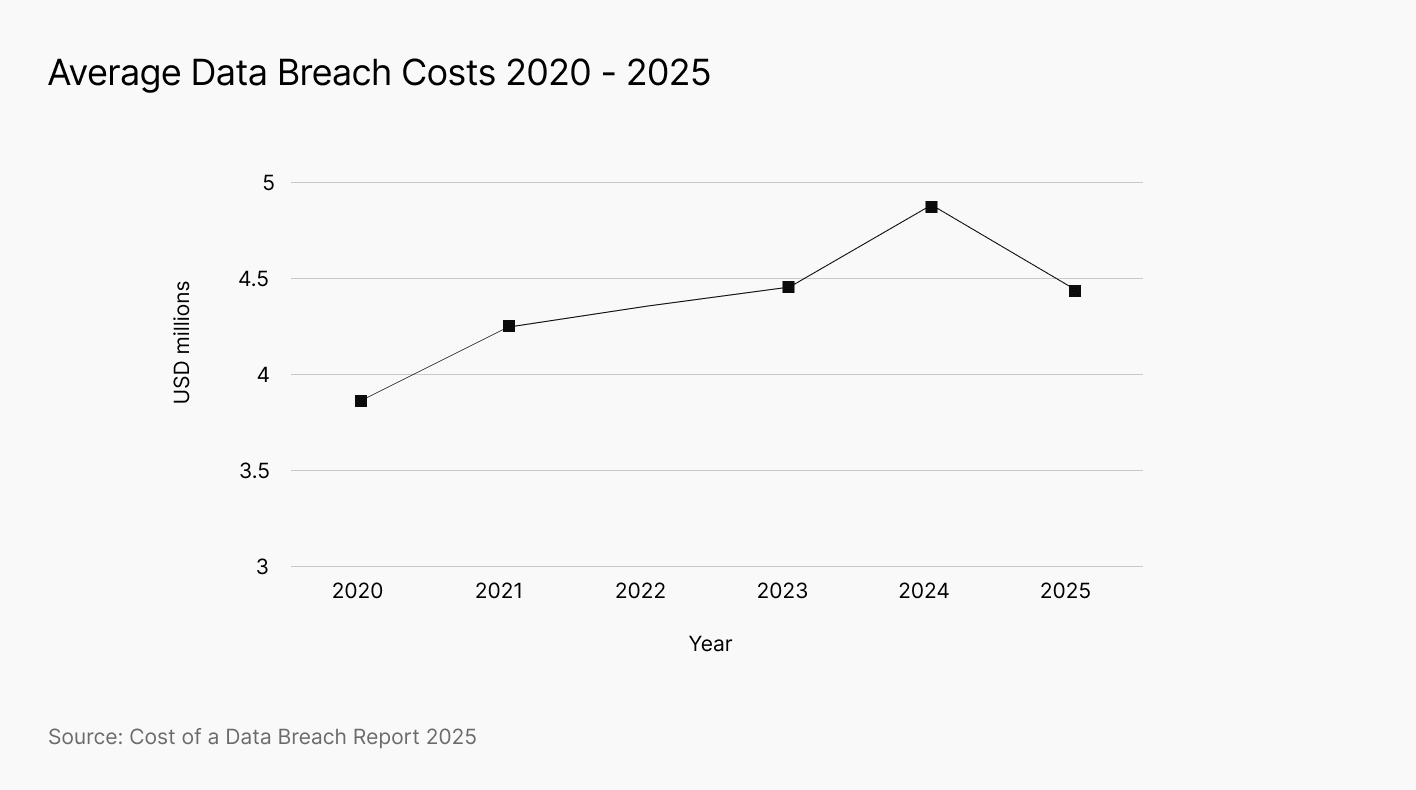 The typical price of a knowledge breach has declines for the primary time since 2020.Important instruments for steady monitoring
A contemporary cyber risk monitoring technique depends on an built-in safety stack the place key applied sciences work collectively to offer complete visibility and automate response. Understanding how these core platforms operate is step one towards constructing a resilient and environment friendly monitoring operation.
SIEM and SOAR platforms
On the core of many fashionable Safety Operations Facilities (SOCs) are two complementary platforms:
Safety Data and Occasion Administration (SIEM)Safety Orchestration, Automation, and Response (SOAR)
Collectively, they type the muse for centralized detection and automatic motion.
Safety Data and Occasion Administration (SIEM) serves because the central nervous system for safety operations. It aggregates log knowledge from throughout your entire IT surroundings — together with networks, cloud infrastructure, and endpoints — to detect anomalies and generate alerts.
A SOAR platform acts because the muscle, taking the alerts generated by the SIEM and mechanically executing response actions by means of pre-defined “playbooks”. This will embrace actions like isolating a compromised endpoint, blocking a malicious IP deal with, or making a ticket for an analyst to research additional.
The first operate of a SIEAM-SOAR mixture is to speed up the incident response lifecycle, instantly shrinking the Imply Time to Detect (MTTD) and Imply Time to Reply (MTTR), which in flip minimizes the monetary and operational affect of a cyber assault.
The first operate of a SIEAM-SOAR mixture is to speed up the incident response lifecycle, instantly shrinking the Imply Time to Detect (MTTD) and Imply Time to Reply (MTTR), which in flip minimizes the monetary and operational affect of a cyber assault.
 Each SIEM and SOAR are recognized as the highest elements in decreasing common knowledge breach prices in 2025. Assault floor administration
Efficient cyber risk monitoring requires an entire and correct understanding of your group’s digital footprint from an attacker’s perspective. Assault Floor Administration (ASM) platforms present this important exterior view by constantly discovering, analyzing, and monitoring all of a corporation’s internet-facing property. These platforms are designed to search out exposures earlier than attackers can exploit them, mechanically scanning for dangers like:
Unknown and untracked property, together with shadow IT and forgotten subdomains.Uncovered providers and open ports.Recognized software program vulnerabilities and misconfigurations.Unsecured AI or LLM endpoints.
Trendy safety methods acknowledge that a corporation’s threat shouldn’t be confined to its infrastructure; it extends to its complete provide chain. Due to this, siloed safety instruments can create harmful blind spots. A complete monitoring program requires a unified platform that mixes exterior ASM for a corporation’s personal property, and people of throughout their provide chain with Third-Occasion Danger Administration.
Platforms like Cybersecurity present this steady, exterior visibility, permitting safety groups to find and prioritize dangers throughout their full digital footprint in addition to the assault surfaces of their distributors, all from a single location
Watch this video to learn the way Cybersecurity approaches Assault Floor Administration:
Discover Cybersecurity Breach Danger >
Id and entry administration options
A strong Id and Entry Administration (IAM) framework is a cornerstone of recent risk monitoring. It’s designed to make sure that solely the precise folks and gadgets can entry the precise sources.
A important element of IAM is implementing the precept of least privilege, which dictates that customers are granted solely the minimal entry rights essential to carry out their assigned features. This apply is essential for limiting the “blast radius” of a safety breach. When an attacker compromises an account, a least-privilege mannequin severely restricts their means to maneuver laterally, escalate privileges, and entry delicate knowledge, successfully containing the risk from the outset.
Past entry controls, fashionable IAM options are integral to a proactive monitoring technique. Since stolen credentials stay a prime preliminary an infection vector for attackers, implementing proactive safety measures is crucial.
This consists of:
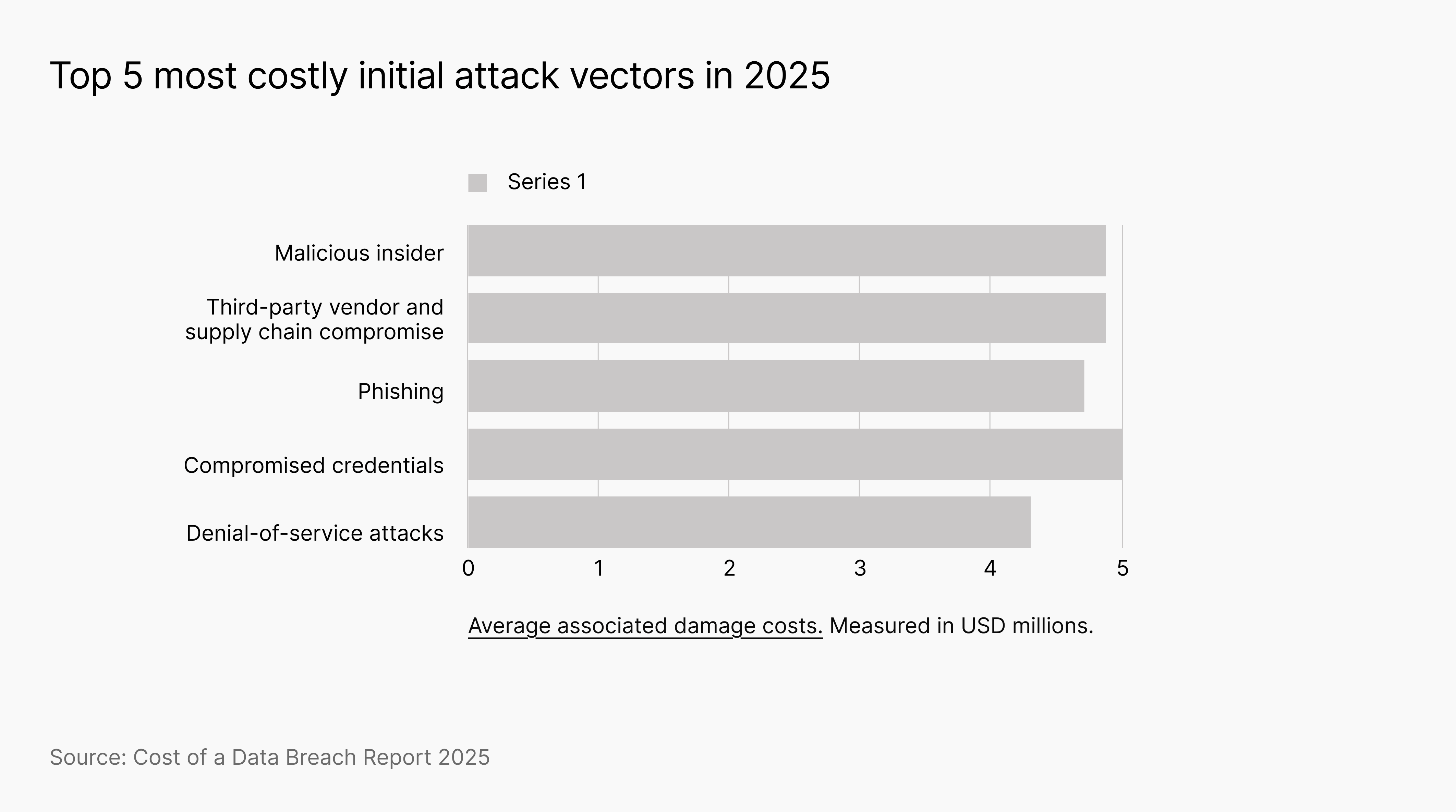
Implementing Phishing-Resistant Multi-Issue Authentication (MFA): Safety consultants strongly advocate transferring past easy MFA strategies to phishing-resistant choices like FIDO2 safety keys or certificate-based authentication. These strategies are designed to thwart social engineering and credential theft assaults that may bypass weaker MFA implementations.Steady Credential Monitoring: Trendy safety platforms constantly monitor the darkish net for leaked company credentials. This serves as an important early warning system, permitting safety groups to detect when an worker’s password has been uncovered in a third-party breach and drive a reset earlier than it may be used maliciously. Compromised credential monitoring has turn out to be a staple characteristic of cyber risk detection instruments.Prime 5 costliest iniital assault vectors in 2025.AI-powered intelligence and triage
Maybe probably the most important evolution in risk monitoring is utilizing synthetic intelligence to automate the labor-intensive strategy of risk triage. Trendy AI, particularly Giant Language Fashions (LLMs), can now operate as a digital Tier-1 analyst, sifting by means of immense volumes of information to floor solely probably the most important, related threats with the context wanted for fast response.
An AI-driven triage system automates the end-to-end strategy of figuring out and getting ready threats for remediation.
These platforms are designed to:
Constantly Scan and Acquire Information: They mechanically monitor numerous sources, together with darkish net boards, ransomware blogs, paste websites, credential dumps, and malware logs.Analyze and Prioritize Threats: Utilizing machine studying, the system analyzes findings and classifies them based mostly on confidence degree, relevance to the group, and potential affect.Suppress Noise and Scale back Alert Fatigue: A significant problem with risk monitoring is the sheer quantity of irrelevant chatter. AI-driven programs intelligently filter out duplicates, stale knowledge, and low-confidence findings to current a curated stream of actionable intelligence, permitting safety groups to give attention to what issues.Combine with Workflows: Findings are offered with context and built-in into remediation workflows the place analysts can assign possession, touch upon findings, and observe progress, reworking uncooked knowledge right into a structured incident response.
The strategic advantages of this method are substantial, together with quicker cyber risk detection, a big discount in noise, improved accuracy from ML fashions skilled on huge datasets, and contextual intelligence that permits extra knowledgeable selections.
Automating professional analyst duties with LLMs
Trendy LLMs can now carry out particular, advanced duties that had been as soon as the unique area of human cyber risk analysts. These capabilities are outlined in CTIBench, a benchmark designed to guage Giant Language Fashions (LLMs) in Cyber Risk Intelligence (CTI) purposes.
CTIBench includes 4 cyber risk analyst duties:
CTI-MCQ: A multiple-choice query dataset assessing LLMs’ understanding of CTI requirements, threats, detection methods, mitigation plans, and greatest practices, based mostly on authoritative sources like NIST, MITRE, and GDPR.CTI-RCM: A process requiring LLMs to map Widespread Vulnerabilities and Exposures (CVE) descriptions to Widespread Weak point Enumeration (CWE) classes, evaluating their means to categorise cyber threats.CTI-VSP: A process involving calculating Widespread Vulnerability Scoring System (CVSS) v3 scores, testing LLMs’ means to evaluate the severity of cyber vulnerabilities utilizing metrics like Assault Vector and Confidentiality Influence.CTI-TAA: A process the place LLMs analyze risk stories to attribute them to particular risk actors or malware households, assessing their means to establish correlations based mostly on historic risk conduct.
Whereas efficiency varies, benchmark checks present that main fashions are already competent, with a transparent benefit for fashions which are both very massive or particularly skilled on safety knowledge.
LLM Mannequin
Efficiency Abstract
Particular Duties / Notes
ChatGPT-4
Prime Performer
Outperformed all different fashions on most duties, together with A number of Alternative Questions (CTI-MCQ), Root Trigger Mapping (CTI-RCM), and Assault Method Extraction (CTI-ATE). It additionally achieved the very best accuracy for accurately figuring out risk actors (CTI-TAA).
Gemini-1.5
Sturdy on Particular Duties
The highest-performing mannequin for Vulnerability Severity Prediction (CTI-VSP), which includes predicting CVSS scores, was akin to LLAMA3-70B, though the latter outperformed it on three duties.
LLAMA3-70B
Excessive-Performing Open-Supply Mannequin
Carried out comparably to the business mannequin Gemini-1.5 and outperformed it on three of the 5 benchmark duties. It struggled with the Vulnerability Severity Prediction (CTI-VSP) process.
ChatGPT-3.5
Mid-Tier Performer
Efficiency was higher than that of the smaller LLAMA3-8B mannequin, however the bigger fashions usually surpassed it throughout most benchmark duties.
LLAMA3-8B
Restricted on Complicated Duties
As a smaller mannequin, it couldn’t match the efficiency of bigger fashions on duties that required extra nuanced reasoning and understanding. Nevertheless, it nonetheless carried out decently on the CTI-MCQ process.
All Fashions (Basic Discovering)
Liable to Related Errors and Overestimation
The bigger fashions (ChatGPT-4, Gemini-1.5, and LLAMA3-70B) usually made comparable errors when answering questions. All examined fashions incorrectly answered a shared set of 293 questions, notably these about mitigation, instruments, and adversary methods. Moreover, all fashions tended to overestimate the severity of threats within the CTI-VSP process.
Finest practices to strengthen cyber defenses
Safety leaders should combine these instruments right into a strategic monitoring program constructed on proactive discovery, documented response plans, and fixed validation to remain forward of a brand new age of quicker and extra environment friendly breach ways.
1. Leverage AI and LLMs to scale risk monitoring
The continued cybersecurity abilities scarcity stays a significant problem, with over half of breached organizations reporting excessive ranges of staffing shortages..
AI and LLMs supply a robust resolution to this drawback by performing as a drive multiplier for safety groups. Trendy LLMs can now carry out many duties {that a} cyber risk analyst would usually deal with, equivalent to gathering numerous risk intelligence, analyzing it for relevance, and correlating it with potential threats of their community surroundings.
This evaluation, which may take a human analyst hours, can usually be accomplished by an LLM in seconds. By leveraging these instruments to automate routine evaluation and intelligence gathering, safety groups can scale their monitoring capabilities, releasing human consultants to give attention to extra advanced investigations and strategic protection.
2. Mapping the digital footprint
A core precept of cybersecurity is that you simply can not defend what you are unaware of. A foundational greatest apply is the proactive and steady discovery of each asset throughout your group’s digital footprint.
This course of should transcend periodic scans to offer a real-time stock of all {hardware}, software program, cloud cases, domains, IP addresses, and SaaS purposes. Sustaining a present, mechanically up to date asset stock is important to getting ready for incident response and serves as the muse for your entire safety program.
Be taught extra about among the prime cyber risk detection instruments available on the market.
This single supply of fact is crucial for precisely defining the scope of cyber risk monitoring, enabling efficient vulnerability administration, and permitting incident responders to know the potential affect of a breach shortly.
3. Defining incident escalation paths
Advert hoc responses to cyber threats are a recipe for failure. A important greatest apply is establishing a proper, documented Incident Response Plan (IRP) that gives a transparent roadmap for motion when an incident happens.
In line with NIST steering, this plan must be based mostly on a proper coverage that defines roles, duties, and authorities throughout the group, clarifying who could make important selections like shutting down a system.
It must also set up clear tips for prioritizing incidents and outline the communication paths for notifying management, authorized groups, and different stakeholders.
To make the plan actionable, organizations ought to create technical “playbooks” with particular, step-by-step procedures for dealing with widespread threats like ransomware or phishing. This complete course of must be overseen by a formally designated Pc Safety Incident Response Workforce (CSIRT), which ensures that response actions are constant, coordinated, and efficient
4. Validating resilience with assault simulations
An incident response plan is just efficient if it has been examined. To make sure readiness and construct “muscle memory,” organizations should validate their defenses and response processes by means of constant, evidence-based assault simulations.
These managed workouts are designed to disclose gaps in visibility, toolsets, and procedures earlier than an actual attacker can exploit them.
There are a number of key strategies for validating resilience:
Pink Teaming: That is an adversarial train the place a devoted staff simulates a real-world attacker’s ways, methods, and procedures (TTPs) to check a corporation’s defenses beneath sensible circumstances.Tabletop Workouts: These are discussion-based eventualities the place safety and enterprise leaders stroll by means of a simulated incident, equivalent to a ransomware assault, to check the decision-making and communication workflows outlined within the Incident Response Plan.Purple Teaming: In contrast to conventional pink vs. blue staff adverserial workouts, it is a collaborative method the place the pink staff (attackers) and blue staff (defenders) work collectively. The pink staff executes particular assault methods, and the blue staff works to detect and reply in real-time, offering fast suggestions to enhance safety controls and tune detection guidelines on the fly.How Cybersecurity will help
Cybersecurity supplies a unified platform to assist safety groups grasp the challenges of recent risk monitoring. The platform combines proactive exterior assault floor administration with superior risk intelligence to offer a single, complete view of your group’s threat.
Cybersecurity’s AI-Pushed Triage can automate the detection and prioritization of exterior threats. This consists of monitoring for:
Leaked company and worker credentials on the darkish net.Uncovered buyer or proprietary firm knowledge.Mentions of your model on illicit boards and marketplaces.
Inside the platform, Cybersecurity’s AI Risk Analyst acts as a digital Tier-1 SOC analyst, streamlining your safety operations by:
Mechanically filtering and prioritizing threats throughout the darkish net, ransomware leaks, credential dumps, and malware logs.Suppressing noise and false positives, surfacing solely high-confidence, actionable threats to cut back alert fatigue.Offering a collaborative investigation workspace with audit trails, proprietor assignments, and remediation monitoring to speed up triage and response.
By unifying exterior visibility with automated intelligence and a collaborative workflow, Cybersecurity empowers safety groups to maneuver from a reactive to a proactive protection, decreasing threat and constructing a extra resilient safety posture.
Discover Cybersecurity Breach Danger >

